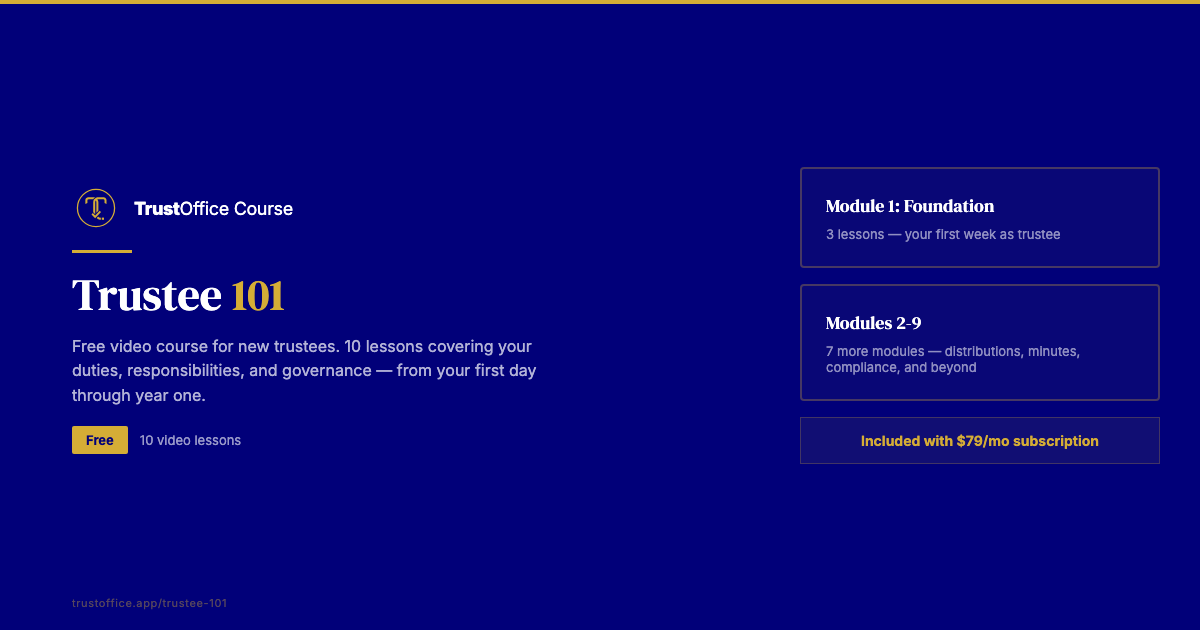
Participate in a Free Trustee Class to Advance Your Expertise This Day
Signing up for a complimentary trustee workshop can tremendously strengthen one's occupational expertise. It furnishes fundamental knowledge on trustee obligations and financial stewardship. Participants can progress at their own pace while building relationships with business leaders. This possibility not only enhances understanding but also facilitates advancement for job progression. However, many may ask themselves what concrete competencies they can expect to obtain and how these can be leveraged in concrete professional situations.

Important Knowledge You'll Master From a Free Trustee Course
A complimentary trustee course furnishes participants with essential skills vital for effective governance and management. The course content typically covers key topics such as financial literacy, allowing trustees to understand budgets, financial statements, and investment strategies. Participants also gain insights into regulatory obligations, guaranteeing compliance with regulations and moral principles.
Additionally, the training boosts strategic planning competencies, furnishing individuals to participate in long-range institutional targets. Effective communication abilities are one more significant feature, allowing directors to express thoughts in a clear manner and work with key parties productively.
Moreover, collaborative and managerial competencies are highlighted, promoting teamwork among board members and promoting a productive deliberation process. Conflict resolution methods are also taught, readying participants to navigate disagreements in a professional manner.
Ultimately, these capabilities not only equip people for their roles as trustees but also enhance their overall administrative abilities, making them valuable assets to any organization.
Top Benefits to Register for a Free Trustee Class for Job Progression
While numerous professionals look for methods to enhance their careers, taking a free trustee course provides distinctive advantages that can significantly enhance one's trajectory. First, these courses deliver essential knowledge about fiduciary responsibilities, strengthening a professional's credibility in their field. Understanding the legal and ethical duties of a trustee can open up additional professional prospects and roles.
Additionally, networking with industry experts and colleagues during these courses can result in strong connections that may support career progression. Participants also acquire practical abilities in financial management and governance, which are highly valued in various fields. Finally, the adaptability of digital learning permits individuals to learn at their own speed, making it simpler to manage education with current work obligations. Overall, enrolling in a free trustee course not only expands knowledge but can also significantly improve professional opportunities and career expansion.
Locating the Excellent Costless Trustee Certification for You
How might one discover the most suitable complimentary trustee program from the wide variety on offer? First, one should consider their particular requirements and professional aspirations, establishing what skills or knowledge deficiencies they intend to cover. Next, studying copyright and framework is important; a structured course description can indicate whether the course will align with your needs.
Moreover, reviewing the credentials of the teaching staff can supply understanding into the excellence of education offered. Feedback from past participants previous students are essential, as they reflect authentic experiences and outcomes.
Finally, copyrightining the pliability of the course format—whether it is self-paced or set—can help in picking a essential resource course that accommodates one's lifestyle. By accounting for these factors, individuals can make a more informed decision, guaranteeing the picked program matches their career ambitions and educational needs.
Smart Strategies for Getting the Most from Your Trustee Course
Achieving the greatest benefits of a trustee course calls for a strategic approach. Participants need to initiate by establishing clear goals and identifying the specific skills or knowledge they aim to acquire. Active participation in the learning experience is essential; this includes joining discussions, posing questions, and working with peers. Regular review of the course materials aids in reinforcing understanding and retention of key concepts.
Furthermore, it is helpful to take notes and create summaries of important topics, facilitating easier revision later. Connecting with fellow participants can provide valuable insights and support, fostering a sense of community. Leveraging supplementary resources, such as recommended readings or web-based discussions, can enhance understanding and implementation of acquired knowledge.
Ultimately, putting into practice the knowledge in practical scenarios, whether through real-life scenarios or simulations, solidifies learning and boosts confidence in trustee duties. By adhering to these approaches, individuals can completely maximize their trustee course training for professional and personal development.
Tangible Implementations of Fiduciary Capabilities in Institutional Management
Trustee competencies play a crucial role in effective governance, allowing individuals to traverse intricate institutional environments. These competencies are critical for fostering openness, responsibility, and principled choices within various entities, including nonprofits, educational institutions, and corporate boards. Trustees equipped with strong analytical abilities can assess organizational results, fiscal well-being, and compliance with regulations, thus improving overall governance.
Moreover, effective communication skills allow trustees to interact with stakeholders, guaranteeing that varied viewpoints are considered in decision-making processes. Conflict resolution skills are equally important, since they help maintain harmony and teamwork among board members and other stakeholders. Additionally, strategic planning abilities enable trustees to synchronize organizational goals with broader missions, guaranteeing longevity and growth. In this way, the use of trustee skills in governance not only strengthens institutional frameworks but also fosters trust and integrity within communities and organizations.
Popular Inquiries That Are Asked Often
Do Gratis Fiduciary Programs Obtain Endorsement from Professional Organizations?
Free trustee educational programs may not always be recognized by trade associations. Accreditation generally relies on the program provider and the specific accrediting body, so participants should validate credentials before entering any course.
How much time Does a Standard Free Trustee Course Take to Finish?
A typical free trustee program generally takes between four to eight weeks to finish. Course duration may differ depending on the provider, material depth, and participant engagement, permitting for flexibility in learning schedules.
Can I Receive a Certificate After Finishing a Free Trustee Course?
Yes, attendees can generally receive a diploma after finishing a free fiduciary course. However, certification availability may differ by organization, so people should verify the specific details with the program provider before enrolling.
May I Register in Multiple Fiduciary Courses, or Exist Limitations?
In typical situations, there is no restriction on how many trustee courses an individual can join. Individuals are encouraged to complete several courses for strengthening their knowledge and skills in trustee functions and stewardship.
What Conditions Do You Have to Register in a Free Trustee Course?
To copyright for a free trustee course, students typically need a basic understanding of financial principles, commitment to the program duration, and sometimes prior experience in fiduciary roles. Particular requirements may diverge by institution.